
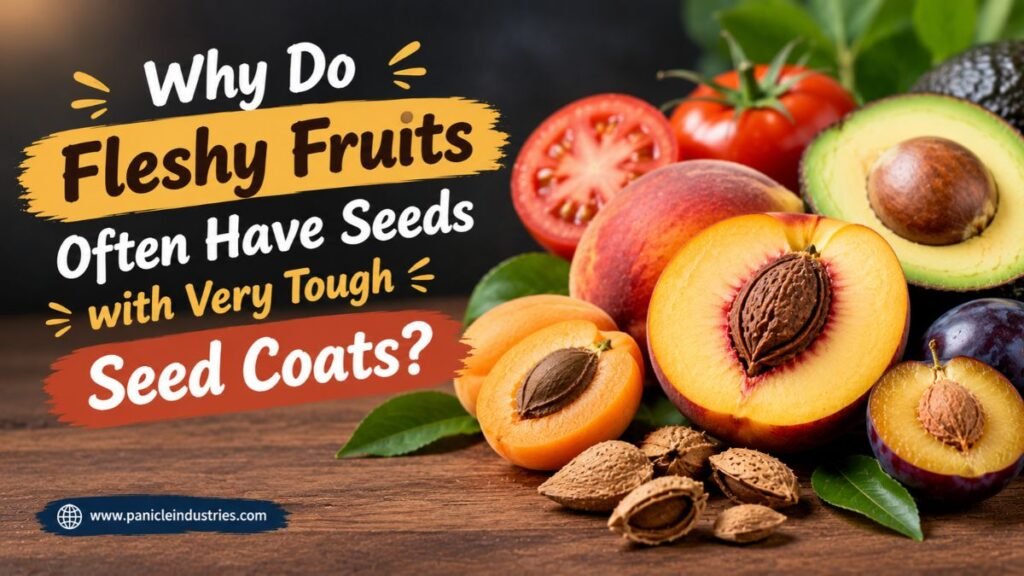
Have you ever noticed that some juicy fruits have seeds that are surprisingly hard? Fruits such as guava, persimmon, and many wild berries contain seeds that can feel much tougher than the soft flesh surrounding them. This difference is not accidental. It is closely connected to how plants protect their seeds and spread them to new places.
Fleshy fruits often have seeds with tough seed coats because the fruit attracts animals to eat it, while the protective seed covering helps the seed survive chewing, digestion, and movement away from the parent plant. This allows some seeds to pass through an animal’s digestive system and reach another location where they may germinate.
The relationship benefits the plant because it gets a natural method of seed dispersal. However, not all fleshy fruits have equally hard seed coats. Some seeds have strong outer coverings, while others are protected by a hard layer of the fruit itself.
Understanding why this happens involves looking at fruit structure, seed protection, animal behavior, and the process of seed germination.
What Are Fleshy Fruits?
Fleshy fruits are fruits with soft, often juicy or pulpy tissues surrounding their seeds. These fruits are commonly sweet, colorful, and attractive to animals.
Examples include:
- Guava
- Grapes
- Berries
- Persimmons
- Cherries
- Plums
- Mangoes
- Tomatoes
The soft and edible part of a fruit develops from the flower after fertilization. In many fruits, the fruit wall is called the pericarp. It may have three main layers: the outer skin, the middle fleshy portion, and the inner layer closest to the seed.
Fleshy fruits are important in nature because many plants use animals to help spread their seeds. Their color, smell, and taste can attract birds, mammals, and other fruit-eating animals. According to the Royal Botanic Gardens, Kew, animals often eat the fleshy pulp while leaving the seeds undamaged, allowing them to be transported and deposited elsewhere.
| Also read: How to Keep Fruit Flies Away from Bananas? |
What Is a Seed Coat?
A seed coat is the protective outer covering of a seed. It develops from the integuments of the ovule and surrounds the young plant embryo and its stored food.
You can think of it as a natural protective covering that helps keep the developing plant safe until conditions are suitable for germination.
The seed coat may be thin, soft, hard, or thick, depending on the plant species. Some seed coats contain tightly packed cells and strengthened cell walls that make them difficult to damage.
A tough seed coat can serve several important purposes:
- Protecting the embryo from physical damage
- Reducing damage from insects and other organisms
- Limiting the entry of water in certain species
- Helping seeds survive unfavorable environmental conditions
- Allowing some seeds to pass through animal digestive systems
The structure of the seed coat varies widely among plants because different species face different environmental challenges.
Why Do Fleshy Fruits Often Have Seeds with Very Tough Seed Coats?
The main reason is seed protection during animal dispersal.
Many fleshy fruits depend on animals to carry their seeds away from the parent plant. The soft pulp attracts animals, while the seeds need to remain healthy enough to produce new plants.
If an animal eats the fruit and destroys every seed inside it, the plant loses that opportunity for reproduction. A durable seed covering can help protect the embryo from damage during this process.
There are several reasons why this protection is useful.
1. To Protect Seeds from Animal Digestion
One major reason for tough seed coats is that seeds may need to survive an animal’s digestive system.
When a bird or mammal eats a fleshy fruit, it often digests the soft pulp but may swallow the seeds without crushing them. The seed then travels through the digestive tract.
During this journey, it can be exposed to digestive fluids, enzymes, moisture, and physical movement. A strong seed coat helps protect the living embryo from damage.
For example, Kew explains that animals such as badgers eat yew berries, digest the pulp, and pass the seeds in their droppings. The seeds can then reach locations away from the original plant.
However, survival is not guaranteed. Some animals chew seeds and destroy them, while others swallow them whole. The outcome depends on the seed and the animal involved.
2. To Help Spread Seeds Away from the Parent Plant
Plants cannot move from one place to another, so they depend on natural processes to distribute their seeds.
Fleshy fruits provide an effective way to attract animals that can carry seeds over different distances. When an animal eats the fruit, it may transport the seeds through its digestive system before releasing them in another location.
This process is known as endozoochory, which means seed dispersal through an animal’s digestive tract.
Moving away from the parent plant can improve the chances of successful growth because young plants may face less competition for sunlight, water, nutrients, and space.
The Royal Botanic Gardens, Kew, explains that animal-assisted dispersal can also help plants reach new habitats and avoid some predators and pathogens.
3. To Prevent Physical Damage to the Embryo
The seed embryo is the part that develops into a new plant. It is delicate and needs protection.
A seed may experience pressure while an animal eats the fruit, moves through vegetation, or travels across the ground. It may also be exposed to rough surfaces, soil particles, and other physical forces.
A strong outer covering acts as a protective barrier around the embryo.
Some seeds have thickened or lignified cell walls that make the outer covering stronger. Lignin is a natural structural substance found in plant cell walls that contributes to hardness and strength.
This type of protection is especially useful for seeds that need to remain intact during dispersal.
4. To Protect Seeds from Unfavorable Environmental Conditions
Seeds do not always germinate immediately after leaving the fruit.
Some need to wait until they experience suitable moisture, temperature, and other environmental conditions. A protective seed coat can help them remain viable during this waiting period.
In certain species, a hard seed coat also limits water absorption. This creates a type of seed dormancy called physical dormancy.
During dormancy, the seed remains inactive even when some conditions may appear suitable. Its protective covering must first become permeable or weaken enough to allow germination.
The University of Florida’s Institute of Food and Agricultural Sciences explains that some hard seed coats have tightly packed outer cells that prevent water from entering until natural erosion or scarification occurs.
This can help seeds avoid germinating too early when conditions are not favorable for seedling survival.
5. To Increase the Chances of Successful Germination
A tough seed coat does more than protect a seed during dispersal. In certain plants, it also helps control when germination takes place.
If a seed germinates while it is still inside a fruit or before reaching suitable soil, the young plant may not survive.
A protective covering can delay water entry or physically restrict the emergence of the young root. When the covering eventually weakens, the seed may absorb water and begin germination.
For some seeds, passage through an animal’s digestive system can help weaken the outer covering. This process is called scarification.
However, animal digestion does not always improve germination. Some seeds benefit from it, others show little change, and some are damaged or destroyed.
How Does Animal Seed Dispersal Work?
The relationship between fleshy fruits and tough seeds becomes easier to understand when you look at the complete dispersal process.
It generally happens in the following stages:
- Fruit development: The plant produces a fruit containing one or more seeds.
- Fruit ripening: The fruit becomes softer, more colorful, and often sweeter or more aromatic.
- Animal attraction: Birds or mammals notice the fruit and eat it.
- Seed protection: Seeds with suitable protective structures may survive being swallowed.
- Seed transportation: The animal carries the seeds away from the parent plant.
- Seed release: The seeds are deposited through droppings or discarded by the animal.
- Germination: If the seed remains alive and finds suitable conditions, it may begin growing.
This process is useful because the animal gets food while the plant gets an opportunity to spread its seeds.
It is not always a perfect relationship. Some animals destroy seeds, and some seeds fail to germinate after dispersal. Successful reproduction depends on several factors, including seed structure, animal behavior, soil conditions, and weather.
Difference Between a Tough Seed Coat and a Hard Fruit Stone
An important point is that a hard seed coat and a hard fruit stone are not the same thing.
People often use the terms interchangeably, but botanically they refer to different structures.
A seed coat is part of the seed itself. A fruit stone, also called an endocarp, is part of the fruit wall that surrounds the seed.
The difference is particularly clear in stone fruits.
| Feature | Seed Coat | Fruit Stone or Endocarp |
|---|---|---|
| Location | Directly surrounds the seed | Inner layer of the fruit surrounding the seed |
| Origin | Develops from the ovule’s integuments | Develops from the ovary wall |
| Main role | Protects the embryo and stored food | Protects the seed from damage and other threats |
| Examples | Tough seed coverings in some berries | Hard pits in mangoes, peaches, and cherries |
Examples of Fruits with Different Protective Structures
Guava: Guava is a fleshy fruit with numerous seeds. Its seeds are dispersed by fruit-eating animals, including birds and mammals.
Berries: Some berries contain seeds with relatively strong seed coats. For example, certain persimmons have hardened seed coverings that help protect their seeds.
Mango: Mango has a large, fibrous inner fruit layer surrounding the seed. This is the endocarp, not the seed coat.
Peach and Cherry: These fruits have hard stones or pits that surround their seeds. The hard structure is part of the fruit wall.
A scientific review published in Frontiers in Plant Science explains that the hardened endocarp in many stone fruits provides a physical barrier that protects the seed against disease and herbivory.
Understanding this difference is important because not every tough structure found inside a fleshy fruit is actually a seed coat.
Do All Fleshy Fruits Have Seeds with Tough Seed Coats?
No. This is an important exception to remember.
Although tough seed coats are useful in many fleshy fruits, not every plant uses the same seed-protection strategy.
Some fruits contain seeds with relatively thin coverings. Others have small seeds that can pass through an animal’s digestive system without being crushed. In certain fruits, the hard endocarp provides most of the protection instead of the seed coat.
Plants have developed different ways of protecting and spreading their seeds according to their environments and the animals that interact with them.
For example, a fruit with a hard stone may rely on the fruit wall to protect its seed, while a berry may depend more on the seed’s own covering.
Therefore, the presence of a tough seed coat is one possible adaptation, not a universal feature of fleshy fruits.
Can a Tough Seed Coat Prevent a Seed from Germinating?
Yes, in certain species.
A very hard or water-resistant seed coat can prevent moisture from reaching the embryo. Since water is essential for germination, the seed may remain dormant until its covering becomes permeable.
This condition is called physical dormancy.
Natural processes can gradually weaken the coat. These include:
- Weathering in soil
- Changes in temperature
- Microbial activity
- Mechanical rubbing
- Passage through an animal’s digestive system
When the coat becomes sufficiently weak, water can enter the seed and the germination process can begin.
However, not all hard seeds have physical dormancy. Some hard coverings protect the embryo without completely preventing water absorption.
The seed’s species and its particular biological characteristics determine how and when it germinates.
Why Are Fleshy Fruits Soft but Their Seeds Hard?
This difference is related to the different jobs performed by the fruit and the seed.
The fleshy part of the fruit helps attract animals. A ripe fruit often becomes softer, sweeter, more colorful, and more aromatic, making it easier for animals to recognize and eat.
The seed, on the other hand, needs to remain protected because it contains the embryo that can produce the next plant generation.
In simple terms:
- The fruit attracts animals.
- The seed carries the next generation of the plant.
- The seed coat helps protect that future plant.
These different features work together to support reproduction and seed dispersal.
Conclusion
So, why do fleshy fruits often have seeds with very tough seed coats? The main reason is to protect the developing plant embryo and improve the chances that seeds will survive dispersal.
Many fleshy fruits attract animals with their soft, sweet, and colorful pulp. When animals eat these fruits, the seeds may be swallowed and transported to other locations. A tough seed coat can protect the embryo from physical damage and digestive conditions during this journey.
In some species, the protective covering also controls water absorption and delays germination until environmental conditions become suitable. Animal digestion may even weaken certain seed coats and help some seeds germinate.
However, not all fleshy fruits have tough seed coats. Some rely on small or resistant seeds, while others use a hard inner fruit wall called the endocarp to protect the seed.
Ultimately, these different structures are part of how plants protect their seeds, reproduce, and spread to new areas.
Frequently Asked Questions (FAQ)
1. Why do seeds inside fleshy fruits have hard coverings?
Hard seed coverings protect the embryo from physical damage, environmental conditions, and sometimes animal digestion while helping seeds survive dispersal.
2. How do animals help spread the seeds of fleshy fruits?
Animals eat ripe fruits and may swallow their seeds. The seeds can travel through the digestive tract and be deposited elsewhere in animal droppings.
3. What is the difference between a seed coat and a fruit stone?
A seed coat surrounds the embryo inside a seed, while a fruit stone is the hardened inner wall of the fruit that surrounds the seed.
4. Can a tough seed coat delay germination?
Yes. In some plants, a hard, water-resistant seed coat creates physical dormancy by preventing water from entering until the covering weakens.
5. Do all fleshy fruits have seeds with tough seed coats?
No. Some have tough seed coats, while others rely on small seeds or hardened fruit walls to protect their seeds during dispersal.