
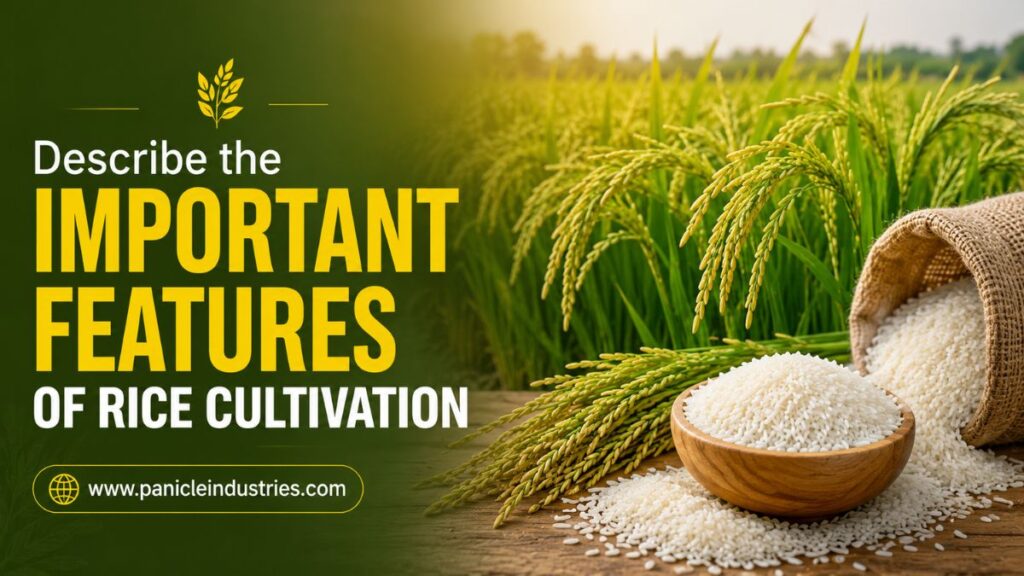
Rice is one of the most important food crops in the world, feeding billions of people every day. From Asia and Africa to parts of Europe and the Americas, rice plays a vital role in food security, rural livelihoods, and the global economy. Because it is grown in diverse climates and farming systems, understanding the important features of rice cultivation is essential for farmers, students, researchers, and anyone interested in agriculture.
Rice cultivation is much more than simply planting seeds and harvesting grains. It requires the right combination of climate, fertile soil, water management, suitable farming practices, and proper crop care to produce healthy yields. Each stage of cultivation directly influences the quality and quantity of the final harvest.
In this blog, we’ll describe the important features of rice cultivation in detail, explaining the natural conditions, farming practices, and essential factors that contribute to successful rice production.
What Is Rice Cultivation?
Rice cultivation is the process of growing rice plants from seed to harvest. It includes several stages, such as land preparation, sowing or transplanting, irrigation, nutrient management, pest control, harvesting, and post-harvest handling.
Although rice can be grown using different methods, the ultimate goal is to produce healthy plants that yield high-quality grains while making efficient use of available resources.
Modern rice farming combines traditional knowledge with improved seeds, advanced machinery, and scientific agricultural practices to increase productivity and sustainability.
| Also read: How Basmati Rice is Made Step by Step |
Why Is Rice Cultivation Important?
Rice is one of the world’s most widely consumed staple foods and supports millions of farming families.
Its importance extends beyond food production because it also contributes to:
- Food security
- Employment opportunities
- Rural economic development
- International trade
- Agricultural sustainability
Countries such as India, China, Bangladesh, Vietnam, Thailand, and Indonesia depend heavily on rice cultivation for both domestic consumption and exports.
Important Features of Rice Cultivation
Several natural and agricultural factors determine the success of a rice crop. Understanding these features helps farmers improve productivity while maintaining crop quality.
1. Suitable Climate
Climate is one of the most important features of rice cultivation.
Rice grows best in warm and humid conditions throughout most of its growing period. Temperature, rainfall, humidity, and sunlight all influence plant growth and grain development.
Ideal Temperature
Rice generally performs well when temperatures remain between 20°C and 35°C during the growing season.
Different growth stages require slightly different temperature ranges:
- Germination requires warm soil.
- Vegetative growth benefits from consistent warmth.
- Flowering is highly sensitive to extreme temperatures.
- Grain filling requires favorable weather for proper development.
Very low temperatures can slow growth, while excessive heat during flowering may reduce grain production.
Rainfall
Rice is a water-intensive crop.
Most traditional rice-growing regions receive abundant seasonal rainfall, helping maintain adequate moisture throughout the growing season.
In areas with limited rainfall, irrigation systems provide the necessary water for successful cultivation.
2. Fertile Soil
Another essential feature of rice cultivation is fertile soil.
Rice plants require nutrient-rich soil that supports healthy root development and strong plant growth.
Ideal Soil Types
Rice grows well in several soil types, including:
- Clay soil
- Clay loam
- Silty clay
- Alluvial soil
These soils retain water effectively, making them suitable for flooded rice fields.
Soil Fertility
Healthy soil should contain adequate levels of:
- Organic matter
- Nitrogen
- Phosphorus
- Potassium
- Micronutrients
Regular soil testing helps farmers determine nutrient levels and apply fertilizers more efficiently.
3. Adequate Water Supply
Water management is one of the defining characteristics of successful rice cultivation.
Unlike many other cereal crops, rice thrives in fields that remain moist or partially flooded during much of the growing season.
However, modern farming practices are increasingly focusing on efficient water use to conserve resources.
Sources of Irrigation
Farmers obtain irrigation water from various sources, including:
- Rivers
- Canals
- Reservoirs
- Tube wells
- Rainwater harvesting systems
Proper irrigation ensures healthy plant growth while reducing the risk of drought stress.
Efficient Water Management
Good water management helps:
- Improve crop growth
- Reduce weed competition
- Maintain soil moisture
- Increase grain yield
- Conserve water resources
Many farmers now adopt alternate wetting and drying techniques to reduce water use without significantly affecting production.
4. High-Quality Seeds
Good seeds form the foundation of a successful rice crop.
Using certified, disease-free, and high-yielding seed varieties significantly improves productivity.
High-quality seeds provide several advantages:
- Better germination
- Uniform crop growth
- Improved disease resistance
- Higher grain quality
- Better yield potential
Many agricultural research institutions continue developing improved rice varieties that can withstand drought, floods, pests, and changing climate conditions.
5. Proper Land Preparation
Land preparation creates favorable conditions for planting and early crop establishment.
Before sowing, farmers usually:
- Plow the field.
- Remove weeds and crop residues.
- Level the land.
- Prepare irrigation channels.
A well-prepared field offers several benefits:
- Better water distribution
- Improved root growth
- Easier transplanting
- Reduced weed problems
- Uniform crop establishment
Laser land leveling is becoming increasingly popular because it improves irrigation efficiency and reduces water wastage.
6. Appropriate Planting Methods
Rice can be cultivated using different planting methods depending on local conditions, labor availability, and farming practices.
Transplanting
This traditional method involves growing seedlings in a nursery before transferring them to the main field.
Benefits include:
- Better plant spacing
- Higher survival rates
- Easier weed management
- Improved yield potential
Direct Seeding
Seeds are planted directly into the prepared field using manual or mechanical methods.
This method:
- Saves labor
- Reduces production costs
- Requires less transplanting effort
- Is increasingly popular in mechanized farming
Choosing the right planting method depends on climate, soil conditions, available labor, and farm size.
7. Balanced Nutrient Management
Rice plants require a continuous supply of nutrients throughout their growth cycle.
Farmers commonly apply fertilizers containing:
- Nitrogen
- Phosphorus
- Potassium
In addition, organic materials such as farmyard manure and compost improve soil structure and increase long-term fertility.
Balanced fertilization helps achieve:
- Strong root development
- Healthy green leaves
- Better flowering
- Higher grain production
- Improved grain quality
Applying fertilizers according to soil test recommendations also reduces unnecessary costs and minimizes environmental impact.
8. Effective Weed Management
Weeds are one of the biggest challenges in rice cultivation. They compete with rice plants for sunlight, water, nutrients, and space, reducing crop growth and grain yield.
Effective weed management is therefore an important feature of rice cultivation.
Farmers use several methods to control weeds:
Manual Weeding
In many traditional farming systems, weeds are removed by hand or with simple tools. Although labor-intensive, this method is environmentally friendly and highly effective when done regularly.
Mechanical Weeding
Mechanical weeders help reduce labor while improving efficiency, especially in larger fields.
Chemical Weed Control
Selective herbicides may be used under proper guidance to control weed growth. Responsible application ensures effective weed management while minimizing environmental impact.
A combination of these methods often provides the best results.
9. Pest and Disease Management
Healthy rice crops require continuous monitoring to protect them from pests and diseases.
Some common rice pests include:
- Stem borers
- Brown planthoppers
- Leaf folders
- Rice bugs
Rice crops may also be affected by diseases such as:
- Blast disease
- Bacterial leaf blight
- Sheath blight
- False smut
Integrated Pest Management (IPM)
Many farmers now follow Integrated Pest Management (IPM), which combines different strategies to reduce crop damage while limiting excessive pesticide use.
These strategies include:
- Regular field inspection
- Resistant rice varieties
- Biological control methods
- Proper field sanitation
- Judicious use of approved pesticides
IPM helps maintain crop health while supporting sustainable farming practices.
10. Proper Harvesting Time
Harvesting at the right stage is another important feature of rice cultivation.
If rice is harvested too early, grains may remain immature and have higher moisture content. Delayed harvesting, on the other hand, can lead to grain shattering, lodging, and losses due to birds or adverse weather.
Signs That Rice Is Ready for Harvest
Farmers typically harvest rice when:
- Most grains turn golden yellow.
- Panicles bend under the weight of mature grains.
- Grain moisture reaches the appropriate level.
- Plants have completed the grain-filling stage.
Depending on farm size, harvesting may be done manually or with combine harvesters that cut, thresh, and clean the crop in a single operation.
11. Post-Harvest Management
The work doesn’t end after harvesting. Proper post-harvest handling is essential to preserve grain quality and reduce losses.
Drying
Freshly harvested rice contains high moisture, making drying one of the first post-harvest steps. Drying lowers moisture content to safe storage levels and helps prevent mold growth.
Threshing
Threshing separates the grains from the harvested plants. Modern threshers improve efficiency and reduce grain damage.
Milling
The harvested paddy is processed to remove the husk and bran layers, producing brown or white rice depending on the milling process.
Storage
Proper storage protects rice from insects, rodents, moisture, and fungal contamination. Clean, dry, and well-ventilated storage facilities help maintain grain quality for longer periods.
Effective post-harvest practices reduce food waste and increase farmers’ profits.
12. Use of Modern Farming Technology
Technology is transforming rice cultivation around the world. Many farmers are adopting innovative tools and equipment to improve efficiency, reduce costs, and increase yields.
Examples include:
- Laser land leveling
- Mechanical transplanters
- Combine harvesters
- Drones for crop monitoring
- Soil testing equipment
- Smart irrigation systems
These technologies help farmers make better decisions, optimize resource use, and improve overall productivity.
13. Sustainable Rice Cultivation
As global demand for rice continues to grow, sustainable farming has become increasingly important.
Sustainable rice cultivation focuses on producing high yields while protecting natural resources for future generations.
Sustainable Practices Include:
- Efficient water management
- Crop rotation
- Organic manure application
- Balanced fertilizer use
- Reduced pesticide dependence
- Soil conservation
- Climate-smart farming techniques
These practices not only benefit the environment but also improve long-term farm productivity and resilience.
Common Challenges in Rice Cultivation
Despite advances in agriculture, rice farmers continue to face several challenges.
Some of the most common include:
- Unpredictable weather patterns
- Water scarcity
- Pest and disease outbreaks
- Rising production costs
- Labor shortages
- Soil degradation
- Climate change
Addressing these challenges requires a combination of improved farming practices, government support, agricultural research, and modern technology.
Why Understanding Rice Cultivation Matters?
Learning about the important features of rice cultivation is valuable for more than just farmers. It helps consumers appreciate the effort involved in producing one of the world’s most essential food crops.
For students and agriculture enthusiasts, understanding the cultivation process provides insight into plant science, resource management, and sustainable farming.
For businesses in the rice industry, this knowledge supports better sourcing, quality control, and product development.
As agriculture continues to evolve, adopting efficient and environmentally responsible cultivation methods will play a key role in meeting future food demands.
Conclusion
Rice cultivation is a complex yet rewarding agricultural process that depends on several interconnected factors. From suitable climate and fertile soil to quality seeds, proper irrigation, balanced nutrition, weed control, pest management, and modern technology, every feature contributes to a healthy crop and a successful harvest.
Understanding these important features of rice cultivation not only helps improve farming practices but also highlights the dedication required to produce one of the world’s most important staple foods. By combining traditional knowledge with scientific advancements and sustainable methods, farmers can continue producing high-quality rice while protecting valuable natural resources for future generations.
Frequently Asked Questions
1. What are the important features of rice cultivation?
Rice cultivation depends on suitable climate, fertile soil, adequate water, quality seeds, balanced nutrients, pest control, and timely harvesting.
2. Which type of soil is best for rice cultivation?
Clay and clay loam soils are ideal because they retain water well, support healthy root growth, and provide suitable conditions for rice plants.
3. Why is water important in rice cultivation?
Rice requires consistent moisture for healthy growth. Proper irrigation supports plant development, nutrient uptake, and higher grain production.
4. What is the best climate for growing rice?
Rice grows best in warm, humid climates with temperatures between 20°C and 35°C, adequate rainfall, and plenty of sunlight during the season.
5. How does modern technology improve rice cultivation?
Modern tools like laser leveling, drones, smart irrigation, and harvesters improve efficiency, reduce labor, conserve resources, and increase yields.